Of course, you will find CoRL 2026 posts from plenty of other people on the internet, covering the conference more thoroughly and from all sorts of angles. Here is my humble take, through my own lens.
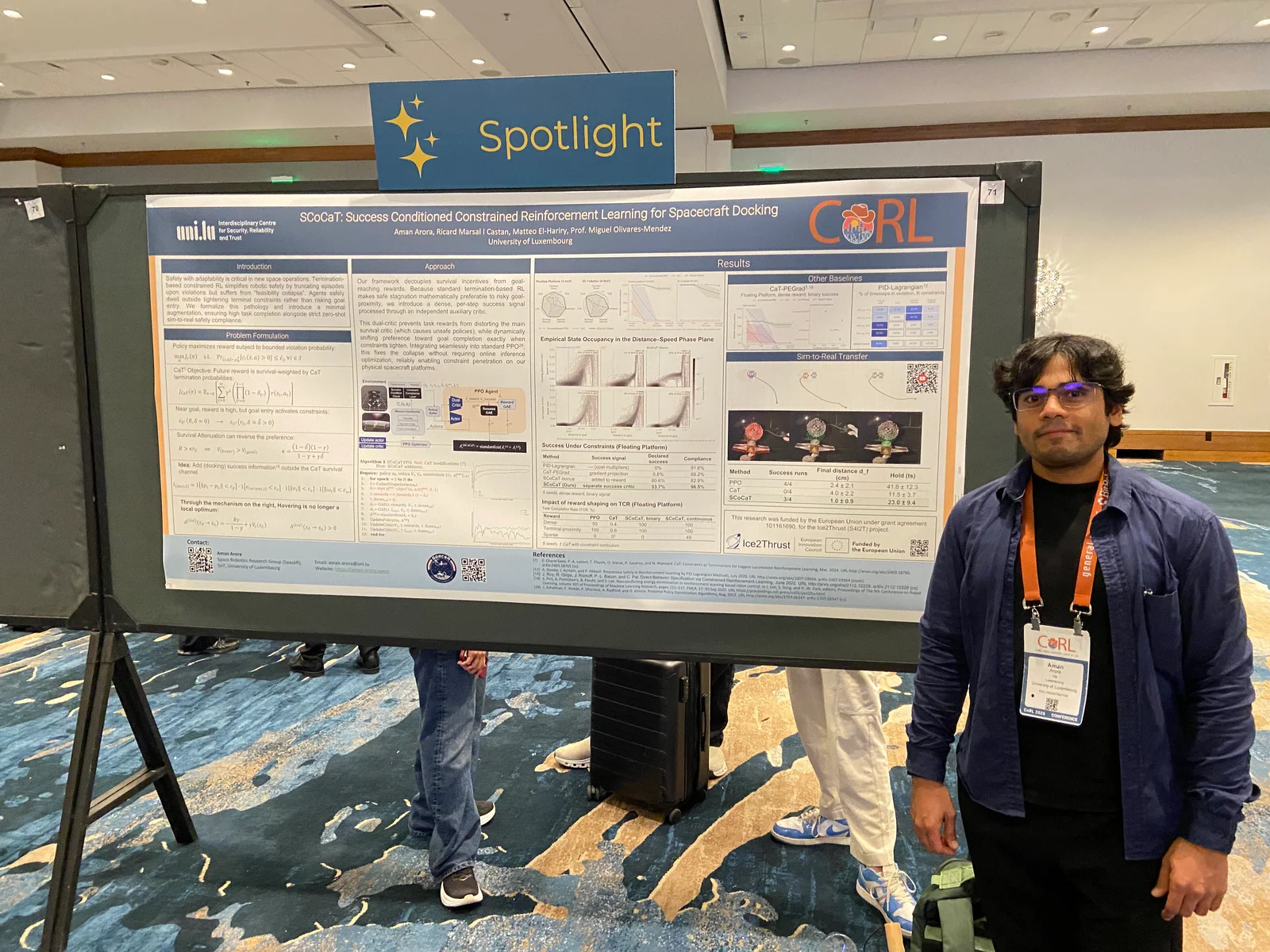
CoRL 2026 in Austin gave me quite a few things to think about. I presented our spotlight paper, SCoCaT, on constrained reinforcement learning for spacecraft docking. Between that, my earlier work on planetary locomotion, and some time spent operating robots in the field, I had my own biases about which papers to go looking for.
Mostly, I was interested in how robots make decisions when the task gets longer, the conditions change, and there are consequences to getting things wrong. Space tends to be fairly unhelpful about second chances.
Here are some papers, posters, and conversations that stayed with me, and a few connections I made while reading afterwards.
From sand to telescopes
Telescopes are Optomechanical Robots had an unfair advantage. It connects my interests in astronomy and robot learning. That poster was always going to catch my attention.
The authors learn individual mirror-alignment skills and compose them to control a distributed-aperture telescope using focal-plane images. They also explore wavefront shaping to suppress light in selected regions. I loved the connection to the science this could enable: better control of an instrument helping us observe something previously out of reach. This is a large part of why I got interested in space robotics.
TERRA: Explore Where It Matters brought me back to my master’s work on quadrupeds walking on sand. It seeks experience that exposes task-relevant errors in a learned world model, then adapts using that experience. The authors report recovering slope-climbing behaviour on the ERNEST rover in three to five trials on deformable Mars-simulant terrain.
What interested me was choosing what to learn. With slip, sinkage, and terrain deformation, there are plenty of ways for a model to be wrong. Some matter more to the next action than others. For planetary exploration, I would want to take this further: can the robot gather useful experience while keeping a way to retreat? Getting permanently stuck would be a rather expensive data point.
Planning, reasoning, and actually doing things
Working on RoboCafe, our PDDL+ task-planning project in Genoa, made me appreciate how much depends on the conditions for an action being satisfied. I kept thinking about this while looking at R³: Training Robots to Reason in Natural Language via Reinforcement Learning. It trains a vision-language reasoner to guide a low-level manipulation policy. Tracking progress and revising decisions as a task unfolds is a direction I find particularly interesting.
CLAP makes a more direct connection: a natural-language action description precedes the numerical action tokens when adapting a vision-language model for control. UMA uses object motion as a shared representation for action generation and dynamics prediction across heterogeneous data. These made me think about what knowledge we can reuse across robots, and what still needs to be grounded in each robot’s physics.
Phase-Conditioned Affordance Fields adds a useful geometric detail: the relevant region of a scene changes with the task phase. Its learned field provides a local reference while preserving SE(3) equivariance. Approaching a spacecraft, aligning with its docking interface, and making contact also require attention to different things. I would be interested in exploring that connection.
Two related papers from this CoRL collection earned a place on my reading list. Hierarchical Planning with Latent World Models connects planning at different temporal scales. How Well Do Latent World Models Understand Partially Observable Safety Constraints? asks whether the learned state contains the information needed for safe control. Its examples include temperature and hidden container contents. A planner cannot sensibly account for a quantity its representation has failed to capture.
Safe enough to finish the task
Our paper, SCoCaT, deals with a frustrating behaviour in termination-based constrained RL. When constraints tighten near a terminal goal, a policy can learn to stay outside that region indefinitely. High compliance, low completion. The spacecraft has become very good at not docking.
We address this feasibility collapse with a dense success signal through an auxiliary value critic, evaluated in spacecraft simulation and on a floating platform testbed. It is why I keep coming back to task completion under constraints when thinking about autonomy.
VertexCBF interested me for a related reason: learning less conservative safe sets. It exploits structure in the dynamics and admissible controls to generate supervision for neural control barrier functions. Retaining more usable control options matters, provided the safety conditions actually hold.
Energy-Based Policy Orchestration considers selecting a controller and its goal together, using learned scores for feasibility and tracking. This seems useful when a planner’s request becomes difficult to execute under changing conditions. I would like to investigate such coordination for spacecraft operations. The learned energy score itself should not be mistaken for a safety guarantee.
Different bodies, different people
π, But Make It Fly studies moving manipulation-pretrained VLAs onto an aerial platform, with synthetic data and payload-aware guidance. Picking up an object changes the dynamics. That is familiar territory when thinking about spacecraft capture and servicing, even though flight and microgravity require very different controllers.
Deployment also means limited computing resources. Don’t Run with Scissors finds that pruning VLAs can hurt performance and increase safety violations, then proposes a recovery method. Coming from embedded systems and now thinking about onboard autonomy, I appreciated the reminder to evaluate the behaviour of the model that actually fits on the robot.
Learning to Assist identifies a wonderfully concrete failure: action chunks can span the transition between waiting and helping, causing a robot to hand over a tool before the person is ready. Being helpful includes knowing when to wait. An observation with applications beyond robotics, perhaps.
Implicit Neural Representations of Individual Behavior learns representations of different policies from unlabelled behavioural episodes. Alongside my interest in assistive systems, it made me curious about adapting to how a particular person works. That is a possible direction to investigate, rather than something I would assume the method already solves.
Which failures have we actually looked for?
SCAPE combines simulation and limited real-world data to estimate performance for specific scenarios. Coverage Aware Active Evaluation uses cheaper proxy systems to guide testing towards likely and diverse failures in a target system.
Both feel very relevant to my work. An average docking success rate can conceal a difficult combination of approach velocity, pose error, and actuator uncertainty. I want to know where the policy struggles, how faithfully simulation represents those conditions, and which hardware experiment would teach us the most. Generating more rollouts is easy to justify. Choosing useful ones takes more thought.
The people building it, and the time to explore
Field AI, Boston Dynamics, Amazon Robotics, Tesla, NVIDIA, and Google DeepMind were particularly fascinating to see. Field AI and Boston Dynamics had a personal connection, having worked with Spot on field deployments in Japan. That experience has stayed with me: I tend to wonder how a system keeps operating when it encounters something unfamiliar, and how often someone needs to step in.
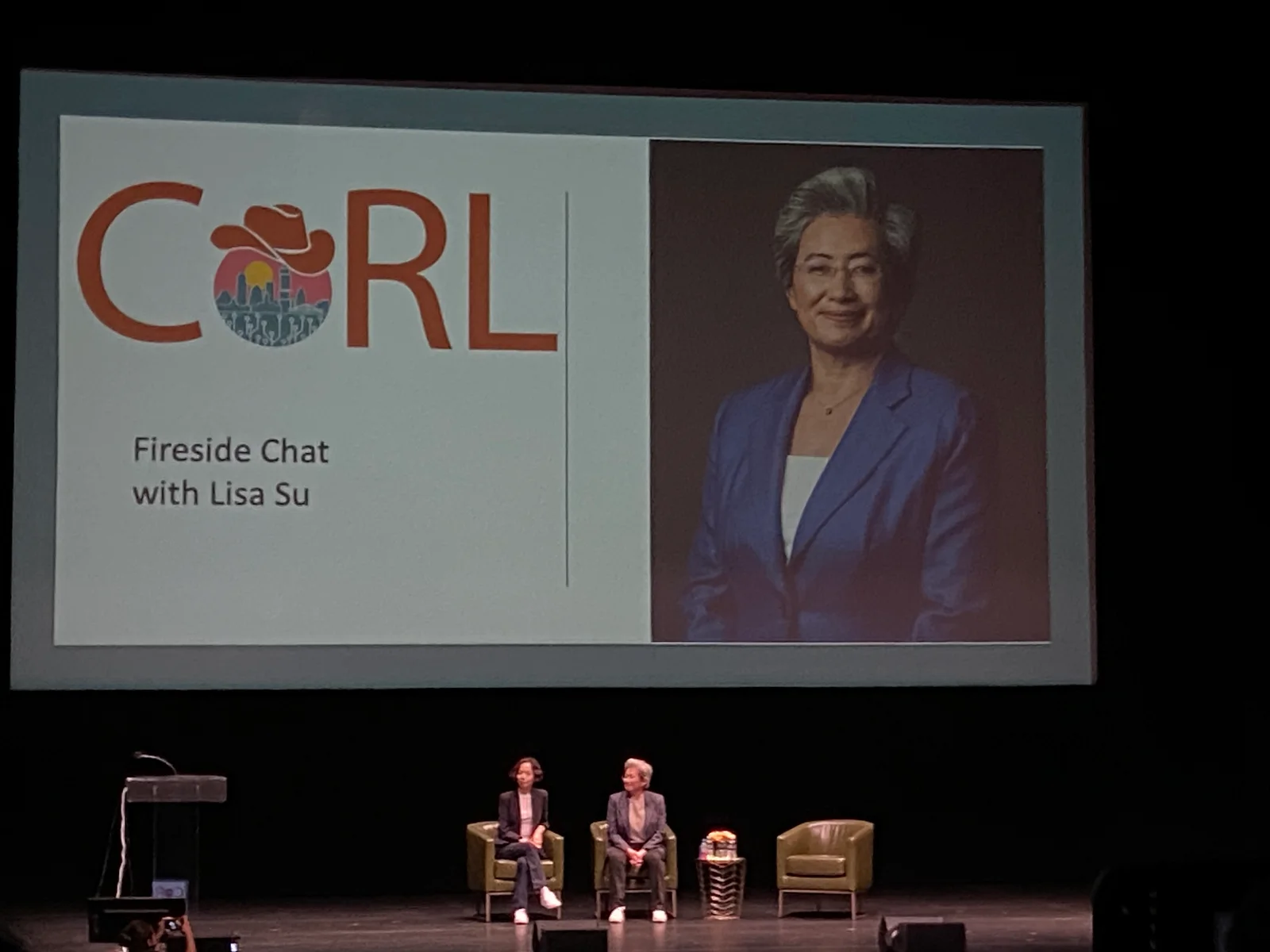
One of my favourite moments was the fireside chat with Fei-Fei Li and Lisa Su. Asked what matters for researchers in this age of AI, Fei-Fei spoke about curiosity and the freedom a PhD offers. I am paraphrasing from my notes: a PhD is not for everyone, and there are more paths into research now. But it can give you protected time to be audaciously curious, pursue a problem with conviction, and be fearless about it. Her joke about tokens competing with human brainwaves also stayed with me. So did Lisa Su’s point about AI being a tool, and the value of the time, freedom, and a positive “bubble” that students generally get during a PhD to explore.
As a PhD student, I appreciated this. It is easy to spend all one’s time keeping up. There is always another paper. Deciding which problem deserves sustained attention needs time too, and so does prioritizing what problem one might feel is closest to them and the most interesting, instead of falling to the temptating of being all over the place.
For me, that direction I saw during this CoRL can be said to be, perhaps, generalized, long-horizon safe decision making. Robots that can approach, inspect, interact, adapt, and recover as conditions change. On a planetary surface, in orbit, or somewhere closer to home. There is more to explore though.
Austin
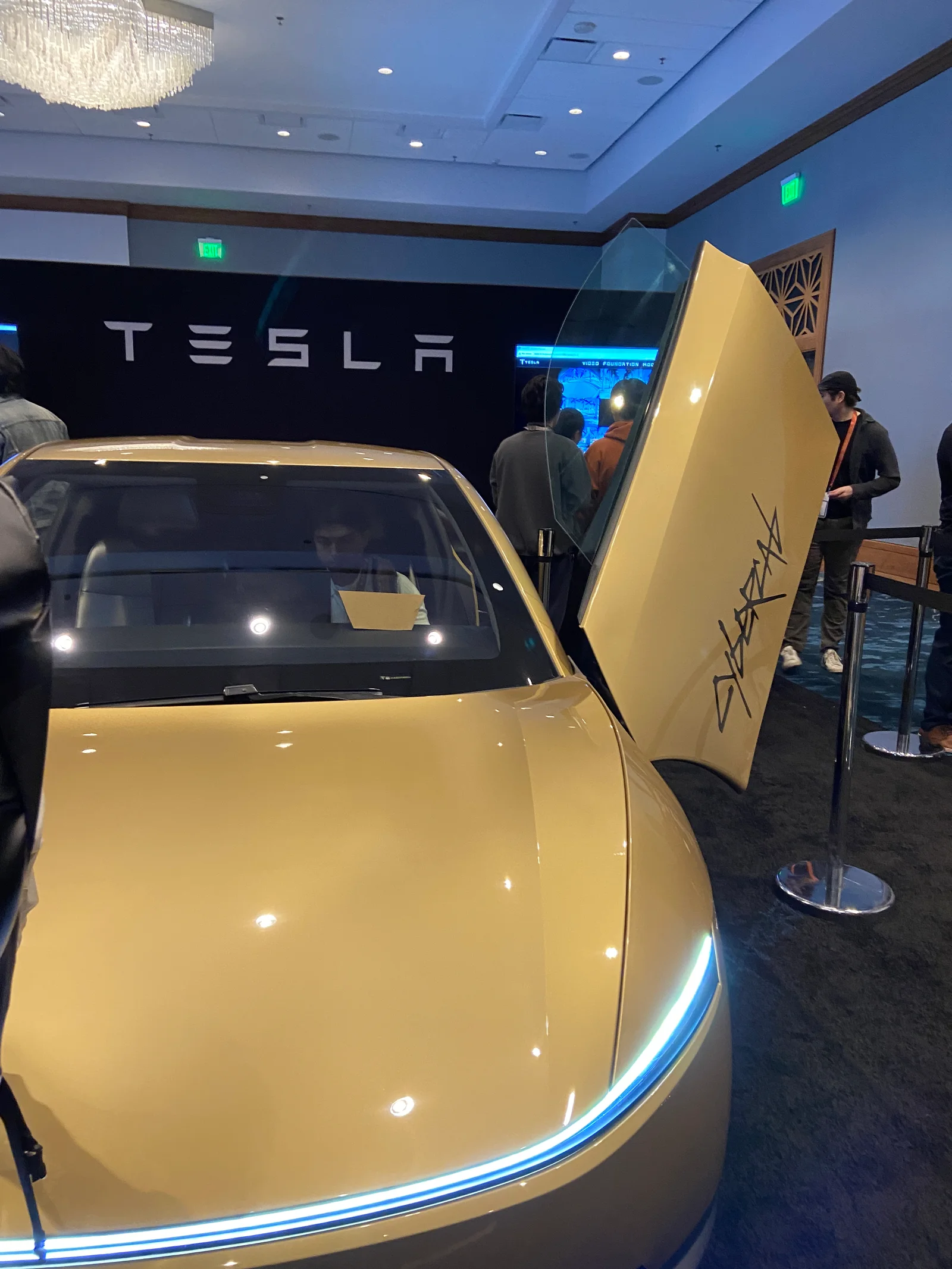
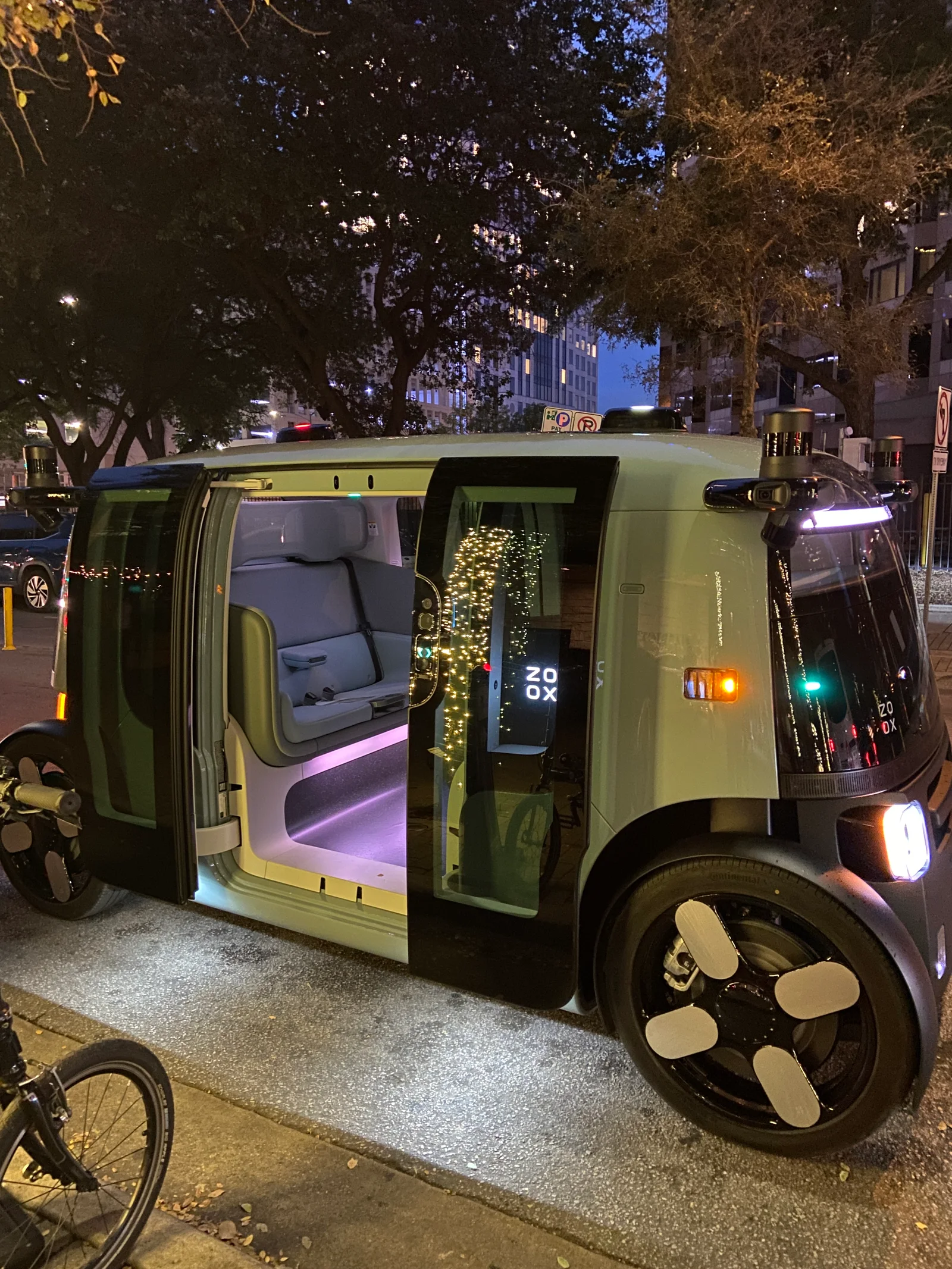
This post would be incomplete without a mention of Austin in particular. What I remember most from my six days there: wonderful live music everywhere, nice people, amazing Texas barbecue, an awesome downtown area and skyline, and lots of autonomous CyberCabs and Waymos driving around. The robot spotting continued well outside the conference venue.

Reflections
CoRL left me with several ideas to investigate, and a good reminder to be a little more audacious about choosing the questions. Helping us explore further and do useful science remains a pretty good reason to keep going.